How to choose a domain name for your business: rules, extensions, examples
A good domain name is short, easy to say over the phone, spelled the way it sounds, and ends in an extension your customers trust — your country's (`.co.uk`, `.de`, `.com.au`) if you serve one country, `.com` if you serve several or sell online. Avoid hyphens, numbers and words with two spellings, check the name isn't someone's trademark, and buy the one or two most obvious variations so nobody else does.
Short answer: the phone test
Say the name out loud to someone and ask them to type it. If they get it right the first time — it's a good domain. Everything else in this guide is a way to pass that test: fewer letters, no ambiguous spellings, no hyphens or digits, and an extension people already know.
Which situation are you in?
- You have a business name (a salon, café, clinic, workshop). The domain should be that name, as close as possible — people search for what's on the sign. If it's taken, add the city or the niche.
- You're still naming the business. Check the domain *before* you order the sign and the Instagram handle: a name whose
.comand local extension are both taken will cost you every day. - You need a domain for email only (
[email protected]). Same rules, but spelling matters even more — people type it from a business card. - You serve customers in several countries or languages. Prefer a Latin-script name and
.com, with local extensions as redirects.
Seven rules for a domain name that works
- Keep it short. Under 15 characters before the dot is comfortable; 6–12 is ideal.
grainroasters.comis easier to say and to fit on a door sticker thangrain-coffee-roasters-and-bakery.com. - Spell it the way it sounds. Avoid words with two spellings (colour/color, Kathrin/Catherine) and “cute” misspellings (
kwik,kafe) — every typo is a lost customer. - No hyphens, no digits. Hyphens are forgotten when dictating;
4instead offorhas to be explained every time. A hyphen is acceptable only when the unhyphenated name is taken *and* you're buying the hyphenated version as a second domain. - Use the name on the sign. Customers who saw your shop search for exactly that name. A domain made of different words (
bestcoffeeintown.com) doesn't help them find you. - Add the city or the niche only if you must.
grainroasters.combeatsgrainroastersleeds.com— unless you plan to stay one-city forever, or the short name is taken. - Avoid other brands and trademarks.
starbucks-leeds.comcan be taken from you through a domain dispute, and a lawyer's letter costs more than any domain. Search the name in your country's trademark register before buying. - Check the handles too. The same name should be free (or close) on Instagram, Facebook and WhatsApp Business — it's one brand.
Which extension: .com, your country's, or a new one like .cafe
The extension (TLD (domain extension)The TLD is the ending of a domain — .com, .de, .cy, .shop. Country endings (ccTLD) signal where you work; .com is the universal default. Price and rules differ per ending.→) is the part after the dot. For a local business it's a choice between three groups:
| Extension | Best for | Watch out for |
|---|---|---|
Your country's (.co.uk, .de, .fr, .es, .gr, .com.cy, .pl, .com.au) | A business that serves one country: locals trust it, search engines treat it as local by default | Some registries ask for a local address or company; usually no WHOIS privacy needed — the registry hides personal data itself |
.com | Several countries, online sales, or when the name is free in .com and you want the “default” address people guess | Most names are taken; .com alone says nothing about where you are |
New endings (.cafe, .salon, .clinic, .shop, .studio, .pizza) | A short, memorable name when everything else is taken: grain.cafe | Renewal prices are often several times higher than .com; some customers add .com at the end out of habit; a few email forms still reject them |
.co, .io, .net, .org | .net/.org as a defensive second domain; .io for tech products | .co is a typo-magnet for .com; .org reads as a non-profit |
Does the domain name affect Google rankings?
Much less than people think. Keywords in the domain (bestdentistleeds.com) give no meaningful boost on their own; a country extension helps Google understand you're local, and a memorable brand name helps people search for you by name — that's what actually brings repeat visits. Pick the name for customers, not for Google, and put the city and niche on the page itself.
Domains in Cyrillic, Greek, Arabic or Hebrew: when they make sense
An IDN (internationalised domain)An IDN is a domain with non-Latin letters (Cyrillic, Greek, Arabic, Hebrew, ä/ö/ü). Under the hood it is stored as a code like xn--…, which is why some services show it strangely.→ is a domain written in a non-Latin alphabet: müller-bäckerei.de, καφέ.gr, مقهى.com. They look native, but come with caveats: browsers and messengers often show them as code (xn--80a...) in links and in email addresses, keyboards abroad can't type them, many booking tools and ad platforms handle them poorly, and some registrars (Cloudflare Registrar, for one) don't support them at all. If your customers mostly type in a non-Latin script, register the IDN in addition to a Latin domain and redirect it — never as the only address.
Should you buy several domains?
- Yes, cheaply: the main domain plus the one or two most obvious variations — the other common extension, the hyphenated or unhyphenated twin, a frequent misspelling. All of them redirect to the main one.
- No: a dozen extensions “for brand protection”. Nobody is going to impersonate a neighbourhood salon in
.biz; renewals add up. - Never run two copies of the website on two domains — search engines treat it as duplicate content. One site, one main address, the rest redirect.
Checklist before you pay
- Passes the phone test (said once, typed correctly).
- Under 15 characters, no hyphens, no digits, no double letters at word joints (
grainnook→grain-nook? better rename). - Matches the business name or is one obvious step from it.
- Extension fits the market (country or
.com); renewal price checked — see how to buy a domain. - Not a trademark, not confusingly close to a well-known brand.
- The same handle is free on the social networks you use.
- The
.comor local twin is bought as a redirect, or at least checked. - Registered to you or your company, with auto-renew on.
Examples: 10 domain patterns for local businesses
| Pattern | Example | When |
|---|---|---|
| Business name | grainroasters.com | Always first choice |
| Name + niche word | grain.cafe, graincoffee.co.uk | Short name is taken |
| Name + city | grainleeds.co.uk | Chain-style brand, one city for years |
| Owner's surname + niche | drkovacsdental.com, martinezplumbing.es | Clinics, lawyers, trades known by the owner |
| Two short words | cutandcolour.co.uk | Salons, barbers, studios |
| Niche + city (descriptive) | barberlimassol.com | No brand yet; easy to remember but hard to own |
| Verb or promise | bookmycut.com | Online booking first |
| Local word or landmark | oldharbourcafe.gr | Tourist areas |
| Abbreviation | gcr.cafe | Only if the full name is long *and* the abbreviation is already used on your sign |
| IDN + Latin twin | καφές.gr → kafes.gr | Non-Latin market, Latin domain remains the main one |
Common mistakes when choosing a domain
- Choosing a name the registrar's generator suggested — long, with a hyphen and a strange extension, because the real one “was taken”. Better to rename than to live with
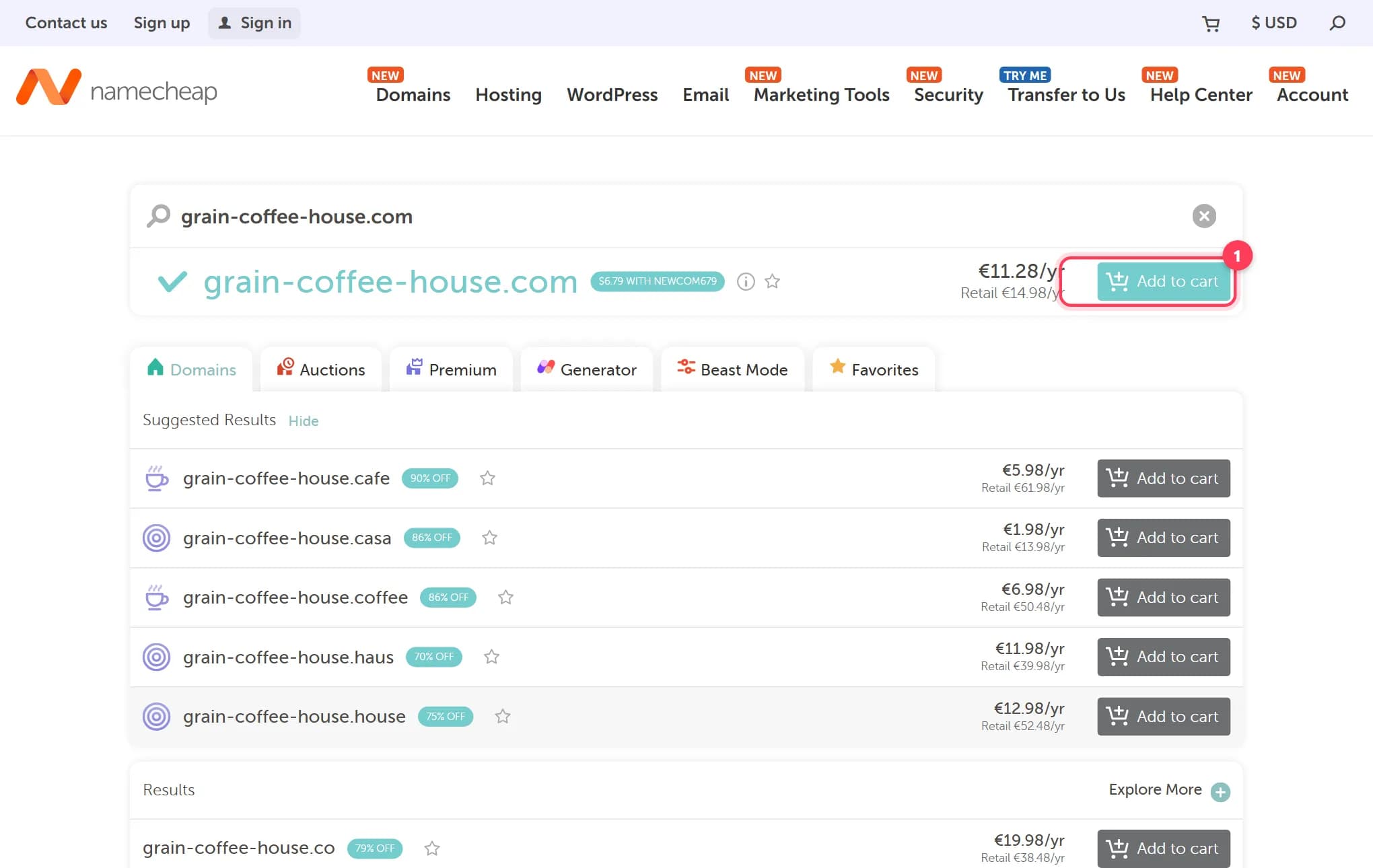
grain-coffee-shop-online.site. - Buying a cheap first-year extension (
.cafeat 90% off) without looking at the renewal. - A name with two spellings that sends half your customers to a stranger's site.
- Ordering the sign first and discovering the domain and handle are taken.
- Registering it to the web designer instead of yourself — see what to do after buying a domain.
What's next
Picked a name? Check it at any registrar and buy it in 15 minutes: how to buy a domain, best domain registrars compared. If it's taken, see what to do when the domain name is taken. And if you'd rather not choose at all — tell your WebFora manager the business name and the city: they pick an available name, send you the link to buy it and connect the domain once it's yours.
FAQ
Should I choose .com or my country's extension?+
One country of customers — your country's extension; several countries or online sales — .com. If both are free and cheap, take both and redirect one to the other.
Is a hyphen in a domain name bad?+
It isn't penalised by search engines, but people forget it when typing and dictating. Use a hyphen only when the unhyphenated name is taken and you plan to buy the other version later if it frees up.
How long should a domain name be?+
Ideally 6–12 characters before the dot, under 15 at most. Shorter names are easier to say, type and print.
Are new extensions like .cafe or .salon worth it?+
They give short, memorable names when .com is taken, but renewals are often several times higher than .com, and some customers add .com out of habit. Good as a main domain only if you also own a .com or local twin that redirects.
Does the domain name matter for SEO?+
Only a little: a country extension signals locality, and a brand people remember brings repeat searches. Keywords in the domain on their own don't rank a site. Choose for customers, not for Google.
Can I use my business name if the .com is taken?+
Yes, with your country's extension or a niche extension — unless the .com belongs to a trademark holder in your industry. Check the trademark register first.
Should I buy a Cyrillic, Greek or Arabic domain?+
Only as an extra that redirects to a Latin domain. Non-Latin domains often appear as code in links and email, can't be typed on foreign keyboards and aren't supported by every registrar or tool.
How many domains should a small business own?+
One main domain plus one or two obvious variations as redirects (the other common extension, the hyphenated twin). Not a dozen — renewals add up and nobody impersonates a local salon in .biz.
Was this guide helpful?
Related guides
How to buy a domain name for your website, step by step
Buy a domain name in 15 minutes: where to buy, what it costs per year, how to dodge renewal traps and upsells. Real registrar screenshots, checked 2026.
9 min readThe domain name you want is taken: what to do
Domain taken? Find a good alternative, see who owns it and when it expires (WHOIS), buy it safely or backorder it — and when to just pick another name.
8 min read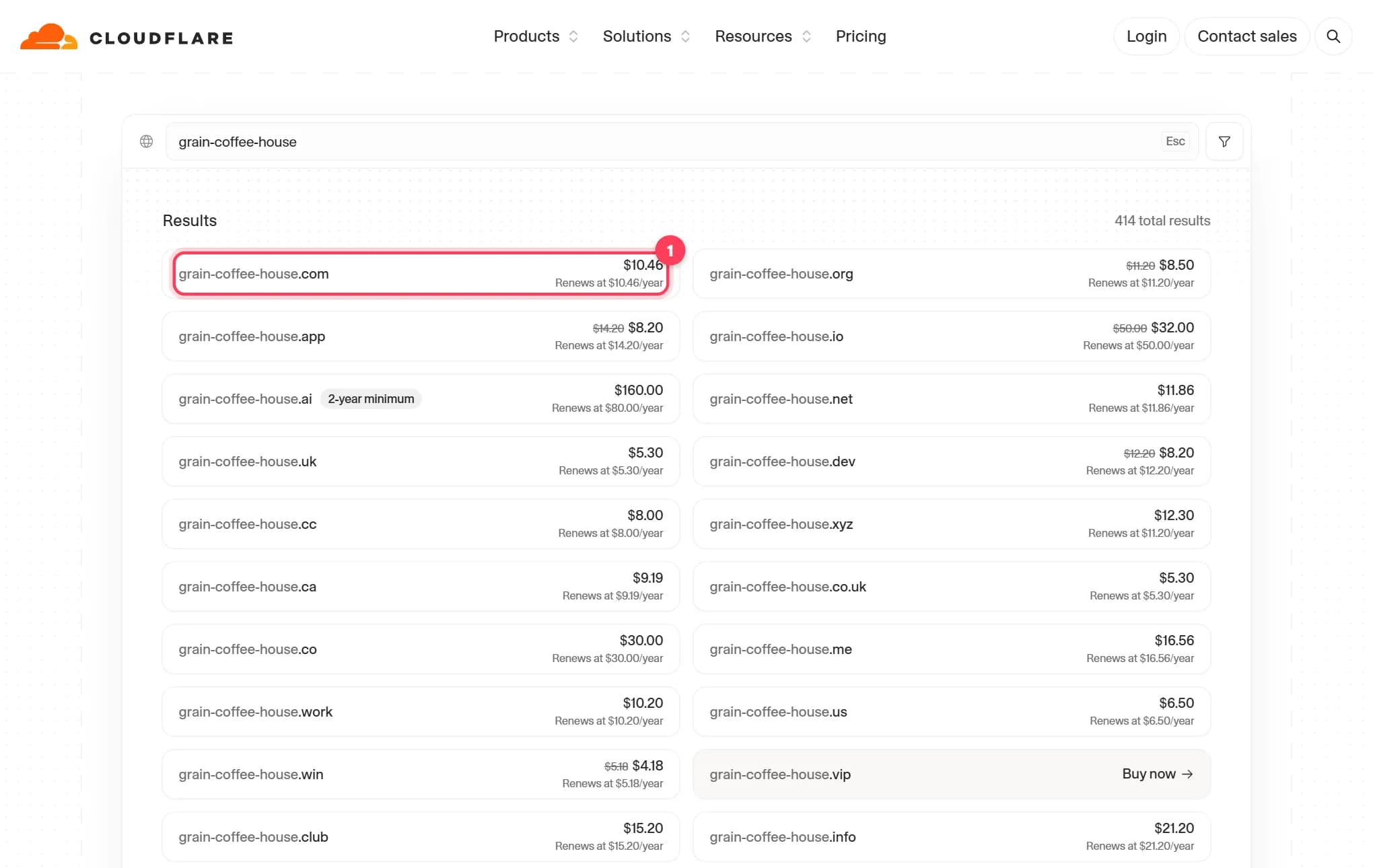
Best domain registrars for a small business: an honest comparison
The best domain registrar for a small business: Cloudflare, Porkbun, Namecheap, GoDaddy, IONOS, Hostinger compared on renewals, privacy and transfers.
10 min read