The domain name you want is taken: what to do
If the domain is taken, you have four options: pick a close variation (another extension, an extra word, your city), check whether it's expiring or for sale via a WHOIS lookup and the page that opens, buy it from the owner through a marketplace or escrow service, or place a backorder in case it drops. For a local business the first option is usually the right one — a name that costs thousands rarely brings more customers than a name that costs ten dollars.
Short answer: four ways out
| Option | Cost | Time | Chance of success |
|---|---|---|---|
| Pick a variation (extension, word, city) | About $10–20/year | 15 minutes | Certain |
| Wait for it to expire and backorder | Tens of dollars for the backorder | Weeks to months, only if it expires | Low — others wait too |
| Buy from the owner (aftermarket) | From hundreds to many thousands | Days to weeks | Depends on the owner |
| Dispute (UDRP) — only if it infringes your trademark | Thousands in fees | Months | Only with a registered trademark and bad faith |
Which situation are you in?
- The domain opens a real website — a working business, a blog. It's not for sale in any realistic sense: go to the variations.
- The domain opens a parking page (“this domain may be for sale”, ads, “buy now”) or nothing at all. The owner is likely an investor or forgot about it — check WHOIS and the price.
- The domain is your own business name or trademark and someone registered it to resell to you. Variations first, dispute only with a lawyer.
- You're still choosing the name. The simplest case: adjust the name before the sign is printed — see how to choose a domain name.
Step 1. Find a variation that's free — usually the best outcome
- Another extension (TLD (domain extension)The TLD is the ending of a domain — .com, .de, .cy, .shop. Country endings (ccTLD) signal where you work; .com is the universal default. Price and rules differ per ending.→).
grainroasters.comtaken →grainroasters.co.uk/.de/.gr(your country's extension, often better for a local business anyway) orgrain.cafe. See which extension to choose. - Add a word. The niche (
grainroasterscafe.com), the city (grainroastersleeds.com), the form (grainroastersshop.com), the article or verb (thegrainroasters.com,visitgrainroasters.com). - A hyphen (
grain-roasters.com) — last resort: people forget it, and the owner of the unhyphenated name gets your typing traffic. - A different, better name. If the taken name is generic (
bestcoffee.com), the real brand is your actual shop name anyway.
Step 2. Check who owns it and when it expires (WHOIS / RDAP)
A WHOISWHOIS is the public lookup that shows who registered a domain, when it expires and which nameservers it uses. Most registrars hide personal details with free privacy protection.→ lookup shows the domain's registrar, registration and expiry dates and, sometimes, the owner's contact. The modern version is called RDAP and shows the same thing. Use lookup.icann.org or the registrar's own WHOIS page. What to look at:
- Expiry date. If it's within weeks and the site is dead, the domain might drop — step 4.
- Status.
clientHold/pendingDelete/redemptionPeriodmean it's already lapsing;ok/clientTransferProhibitedmean it's actively held. - Registrar. Tells you where a backorder or an offer can be placed.
- Owner contact. Usually redacted for privacy; many registrars offer a “contact the owner” form that forwards your message instead.
Then open the domain in a browser. A parking page with “Buy this domain” / “Make an offer” and a price means it's listed on an aftermarket platform. A working website means the owner is using it — a cold offer rarely works and may be unwelcome.
Step 3. Buying a taken domain from the owner — safely
The aftermarket is simply the resale of registered domains. Prices are set by owners and range from a hundred dollars to tens of thousands; short, generic .com names are the expensive ones. How to do it without losing money:
- Use a marketplace or escrow, never a direct transfer of money. Sedo, Afternic, Dan, GoDaddy Auctions and the registrars' own marketplaces hold your payment until the domain is in your account. For a private deal, use an escrow service such as Escrow.com.
- Make a realistic offer. Owners of parked domains expect haggling; start well below the asking price. A broker (offered by big registrars) can negotiate for a fee — worth it only for expensive names.
- After the transfer, check the registrant. The domain must be in *your* account with *your* details before you consider the deal done.
- Mind the 60-day lock. After a change of owner or a transfer the domain can't be moved to another registrar for 60 days — plan the website launch accordingly; the Nameservers (NS)Nameservers are the servers that hold your domain's DNS records. Changing them (usually two addresses like ns1.example.net) hands the whole DNS setup to a new provider — the simplest way to connect a domain to a website.→ can still be changed right away.
Step 4. Backorder: waiting for the domain to drop
When a domain isn't renewed, it goes through a grace period (the owner can still renew) and a redemption period (renewal with a fee), then a short “pending delete” and finally it's released — typically two to three months after the expiry date for .com-type extensions; country extensions have their own timelines. A backorder is a paid request to a service (the registrar's own, DropCatch, SnapNames, NameJet) to try to register the domain the second it's released.
- No guarantee: the owner renews in most cases, and if several people backorder the same name, it goes to an auction.
- You usually pay only if the catch succeeds — read the service's terms.
- Good for: a dead parking page with an expiry date in a few weeks. Bad for: an actively used site.
Trademarks and UDRP: when you can take the domain
If you hold a registered trademark and someone registered the matching domain in bad faith (to sell it to you, to divert your customers, to block you), you can file a UDRP complaint — a dispute procedure under ICANN rules, handled by bodies like WIPO — or go to court. You'll have to show that the domain is confusingly similar to your mark, that the holder has no legitimate interest, and that it was registered and used in bad faith. It costs thousands in fees and takes months, and it doesn't work the other way: if you register a name matching someone else's brand, it can be taken from you the same way. For a neighbourhood business this is almost never the right path — a variation is.
When to just pick another name
- The domain hosts a real business — especially in the same industry.
- The asking price is above what the website is expected to earn you in a year.
- The owner doesn't respond within two weeks — don't stall your launch.
- The name is generic (
cityhairsalon.com): nobody searches for it by name, so it's worth little to you anyway. - You haven't printed anything yet. A free name you can own outright beats a taken name every time.
Common mistakes
- Paying the owner directly by bank transfer or crypto — the domain never arrives.
- Waiting months for a drop while the business has no website at all.
- Registering a brand's name because it “was free” — a dispute later costs the domain and legal fees.
- Taking the
.coor hyphenated twin of a busy.com— customers end up on the other site. - Spending the website budget on the name. Ten dollars for a variation and the rest on the website is the better trade.
What's next
Found a free variation? Buy it in 15 minutes — how to buy a domain and which registrar to pick. Can't decide between variations? Tell your WebFora manager the business name and the city — we'll check what's free, suggest the best option and connect it to your website.
FAQ
The domain is taken but not used — can I get it?+
Sometimes. Check WHOIS for the expiry date: if it's close, place a backorder. If the parking page lists a price, you can buy it through the marketplace. If neither, send an offer via the registrar's contact form — and pick a variation in the meantime.
How do I find out who owns a domain?+
Do a WHOIS/RDAP lookup at lookup.icann.org or on any registrar's site. The owner's details are usually hidden for privacy, but you'll see the registrar, the dates and often a form to contact the owner.
How much does it cost to buy a taken domain?+
Whatever the owner asks — from about a hundred dollars for an ordinary name to tens of thousands for short generic .com names. Plus marketplace or escrow fees. A variation costs $10–20 a year.
What is a domain backorder and does it work?+
A paid request to catch a domain the moment it's released after expiry. It works only if the owner doesn't renew, and if others backorder the same name, it goes to auction. Most expiring domains are renewed.
When does an expired domain become available?+
For .com-type extensions, typically two to three months after expiry: a grace period, a redemption period with a fee, then a few days of pending delete. Country extensions have their own timelines.
Can I force the owner to give me the domain if it's my business name?+
Only with a registered trademark and evidence of bad-faith registration, through a UDRP dispute or court — expensive and slow. If it's a coincidence of names, you can't. Choose a variation.
Is it safe to buy a domain from a stranger?+
Only through a marketplace (Sedo, Afternic, Dan, GoDaddy Auctions) or an escrow service that holds the money until the domain is in your account. Never pay directly.
Should I take the .co or hyphenated version of a taken .com?+
Only if the .com isn't a busy site in your industry — otherwise people typing the obvious address end up with your competitor. Your country's extension or an extra word is usually safer.
Was this guide helpful?
Related guides
How to choose a domain name for your business: rules, extensions, examples
Choose a domain name for a local business: length, spelling by ear, hyphens, .com vs country extension, .cafe endings, trademarks. Checklist + examples.
9 min read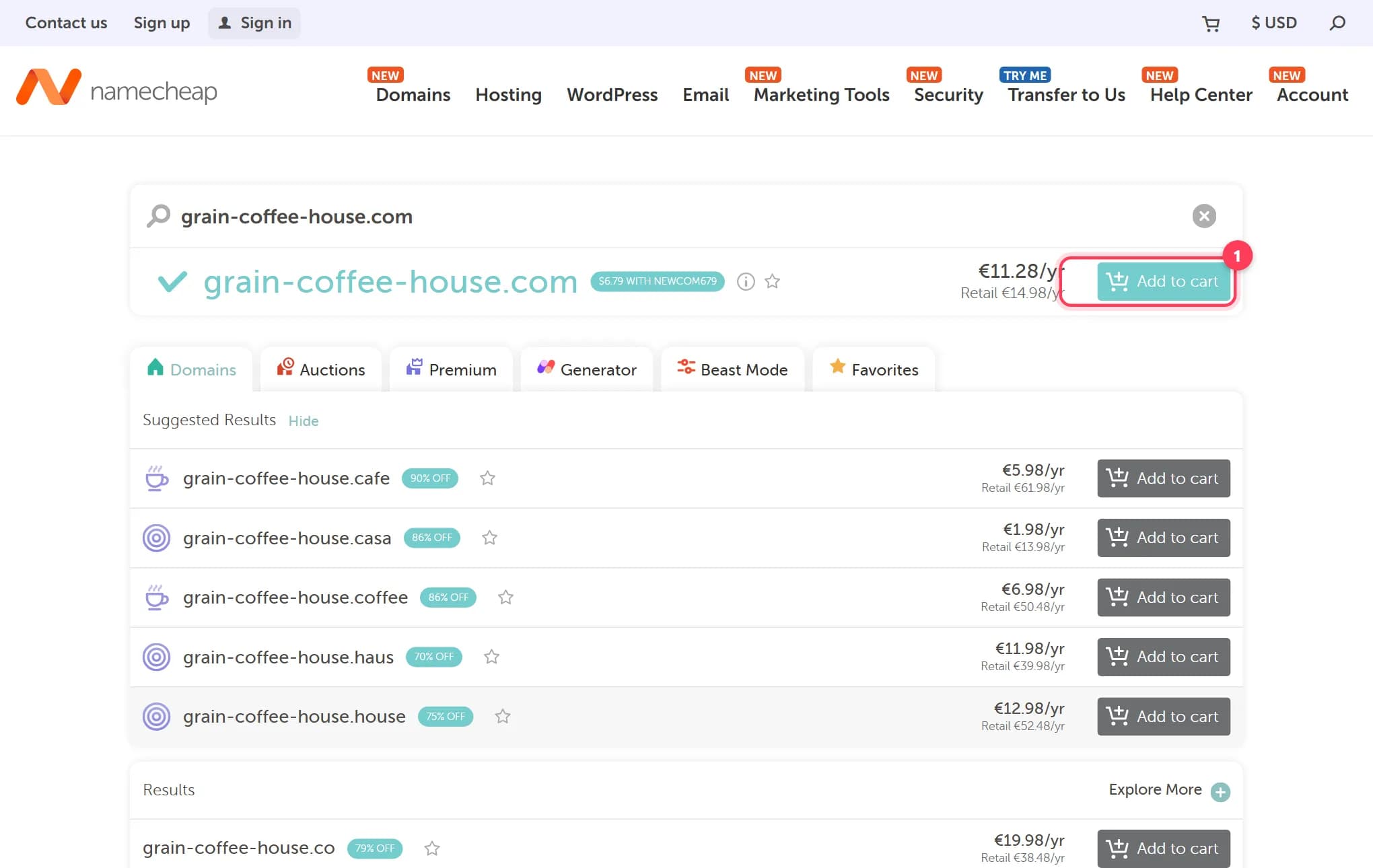
How to buy a domain name for your website, step by step
Buy a domain name in 15 minutes: where to buy, what it costs per year, how to dodge renewal traps and upsells. Real registrar screenshots, checked 2026.
9 min read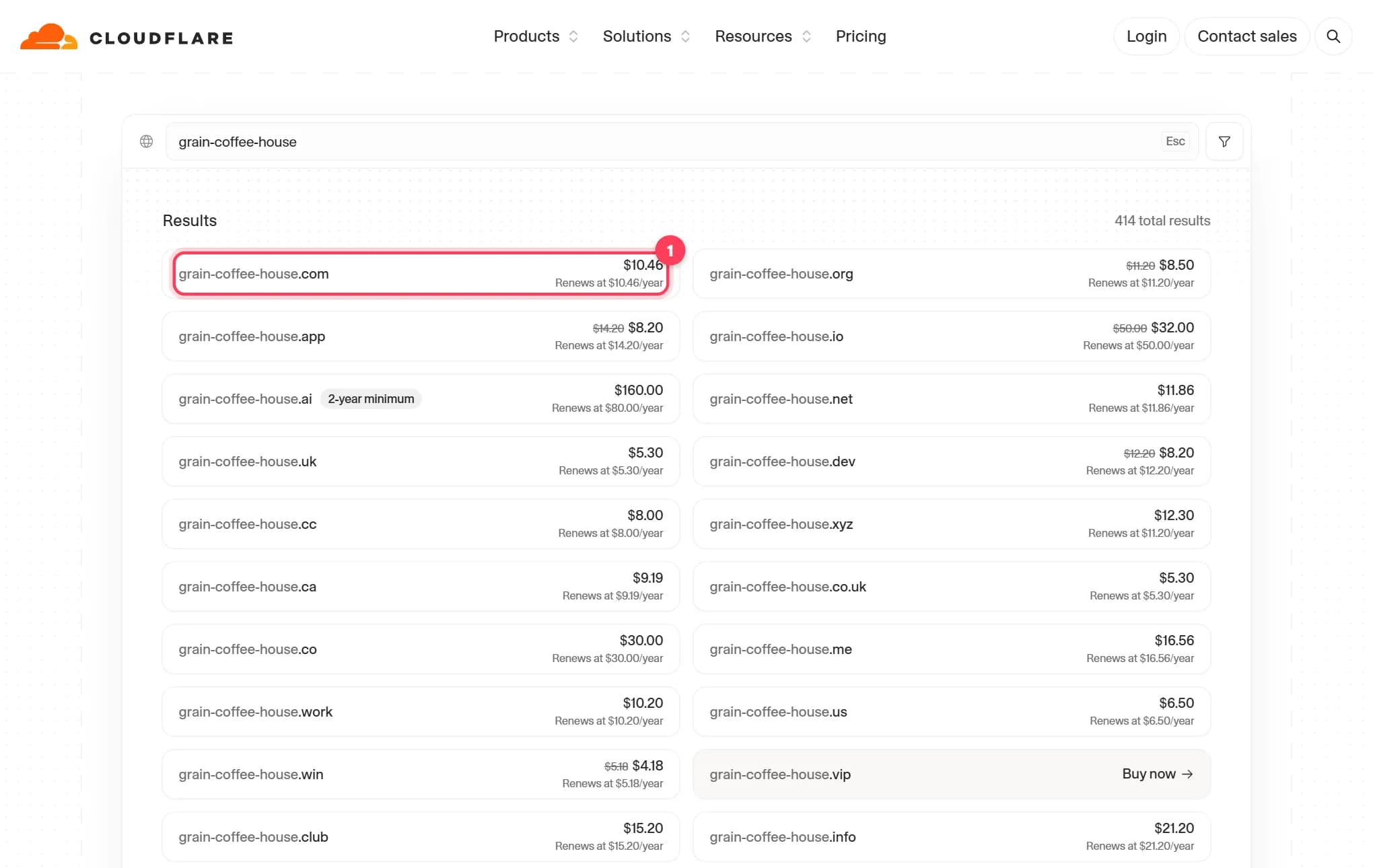
Best domain registrars for a small business: an honest comparison
The best domain registrar for a small business: Cloudflare, Porkbun, Namecheap, GoDaddy, IONOS, Hostinger compared on renewals, privacy and transfers.
10 min read