CRM system, done for you
When leads live in messaging apps, spreadsheets and managers' heads, customers slip away unnoticed. A custom CRM mirrors the way deals actually move in your company — from the first inquiry to the repeat sale.
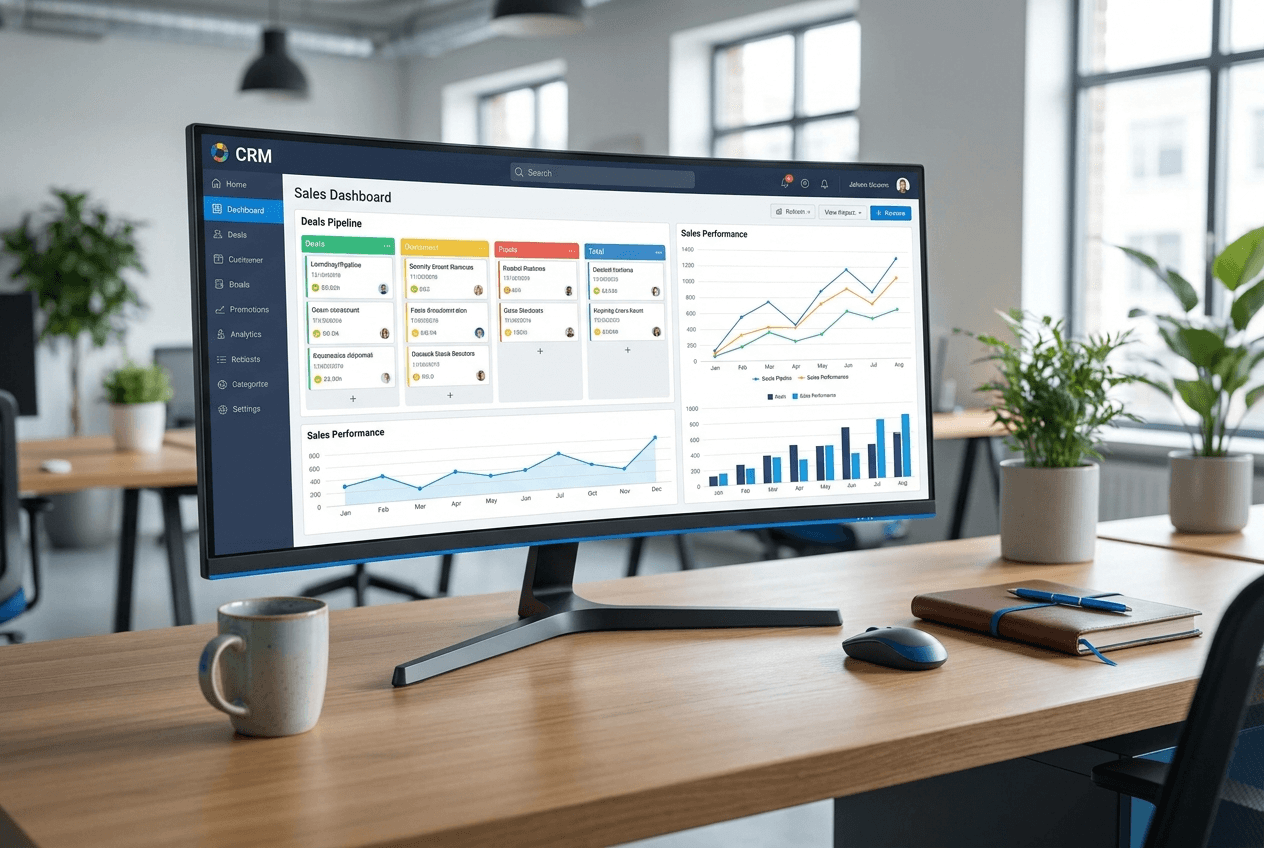
What the “CRM system” project includes
The solution scope we usually plan for a project — the final feature set is fixed at the brief.
Single customer record
Contacts, request history, deals, files and correspondence in one place — any employee quickly understands what happened with a customer.
Pipeline built on your stages
We set up deal stages, required fields and transition rules based on how your sales or service team actually works.
Lead capture from every channel
Requests from your website, email and messengers automatically create a deal and are assigned to the responsible manager right away.
Tasks and reminders
The system creates tasks to call back or send an offer, and reminds you if the deadline has passed while the customer is still waiting.
Roles and access rights
Everyone sees only what they need: managers their own deals, accounting the invoices, and management the reports and metrics for the whole team.
Reports for management
Stage conversion, manager workload and reasons for lost deals in clear reports — no manual spreadsheet consolidation at month-end.
We build a CRM around your processes: leads, deals, clients and analytics in one window. Nothing gets lost, sales under control. Integrations included.
Custom CRM development vs an off-the-shelf CRM
For a small team with a clear sales pipeline, a ready-made cloud service is often the best choice: it can be up and running in a few days and needs no development budget. We’ll tell you so honestly during the brief if your task can be solved through configuration. There’s no point overpaying for something that already exists and works well. Sometimes it’s enough to set up an existing system properly and connect it to your website.
You need your own CRM when your process doesn’t fit a standard pipeline: an order goes through production or several departments, pricing is calculated with your own formulas, contracts and acceptance documents must be generated automatically, and data must be stored on your own server. Another reason is per-user subscription fees that, as your team grows, exceed the cost of your own solution. In such cases the value of your own system lies not in its feature list, but in the fact that it mirrors exactly how you work.
CRM development cost: what it’s made of
The estimate is affected by the number of entities and the relationships between them: clients, deals, orders, properties, contracts. The more roles with different permissions and scenarios, the more interface design work there is. Automations are a separate item: document generation, mailings, calculations and rules by which the system moves a deal to the next stage on its own. Each such rule has to be described, implemented and tested on real examples from your practice.
Integrations make up a significant part of the scope: telephony, email, messaging apps, your website, accounting system. We also account for migrating your client base from spreadsheets or an old program, and for the number of reports. To avoid building what isn’t needed, we often start with the core — records, the pipeline and tasks — and add extra modules once the team is already working in the system. That way the first results come sooner, and improvements are based on the team’s experience rather than guesswork.
How to roll out a CRM your team will actually use
The most common CRM problem isn’t the code, it’s that managers keep tracking clients in notebooks. That’s why, before development, we look at employees’ real working day and strip out of the interface everything that slows them down. A field nobody fills in is better not created at all than forced on the team later. The fewer unnecessary actions, the better the chance the system becomes a familiar place to work.
The rollout happens in stages: first we migrate the database and onboard one group of users, collect feedback and make improvements. Then we bring in everyone else and show them how to work in the system. Company processes change over time, so after launch we stay in touch — a CRM should change along with them rather than turn into an awkward archive. New stages, reports and automations are added as small improvements when a real need for them arises.
This is custom development, done for you: we run a brief, describe the features, design around your business logic, and agree the design, timeline and estimate before work starts. We take on the architecture, development, integrations and launch.
Cost and timeline depend on the scope — we estimate individually for the task, not from a single price list. After launch we stay in touch: support, improvements and product development.
Build your project and see the estimate
Choose the type, the features you need, the design tier and the timeline — you’ll see a preliminary price range and duration. We fix the exact estimate after a short brief.
What matters in the “CRM system” project
We build the solution around what actually moves your business and your processes — not for the sake of it.
The pipeline mirrors your real deal stages, not an imposed template
Leads from the website, calls and messaging apps land in a single customer record
Access rights: managers see their own customers, leadership sees the full picture
Tasks and reminders, so no request goes unanswered
Let’s discuss your project: CRM system
Describe the task in a short brief and we’ll come back with an estimate of scope, timeline and cost. Free, no obligation.
What the project includes
The full cycle — from idea and design to launch and support, by one team with a transparent estimate.
Questions about the “CRM system” project
How do we migrate customers from spreadsheets and our old software?
We export the data, remove duplicates and standardize the fields, then load everything into the new system. Before switching over, you check the result on a test copy.
Can we connect phone systems and messaging apps?
Yes, if the service supports external connections (an API — a programming interface for exchanging data). Calls and messages will appear right in the customer record.
Where will customer data be stored?
Wherever you need: on hosting of your choice or on your own server. Access, backups and data retention rules are discussed before we start.
CRM system: how much does it cost, done for you?
The price depends on the scope: we estimate by features, design and timeline. Describe the task in the calculator on this page to get a “from–to” range, and after the brief we fix the exact estimate. Payment in stages.
Who owns the code and the result?
You do. Once the project is complete and paid for, we hand over the source code, access and documentation. Support and further development can stay with us — by agreement.
We also build websites for others in the “Custom solutions” niche

Shall we discuss your project?
Tell us about the task — we will come back with an estimate of scope, timeline and cost. Free and with no obligation.