The PDF catalog goes out of date and stock and prices need checking
How we solve it
Data comes from your inventory system, so the catalog is always current.
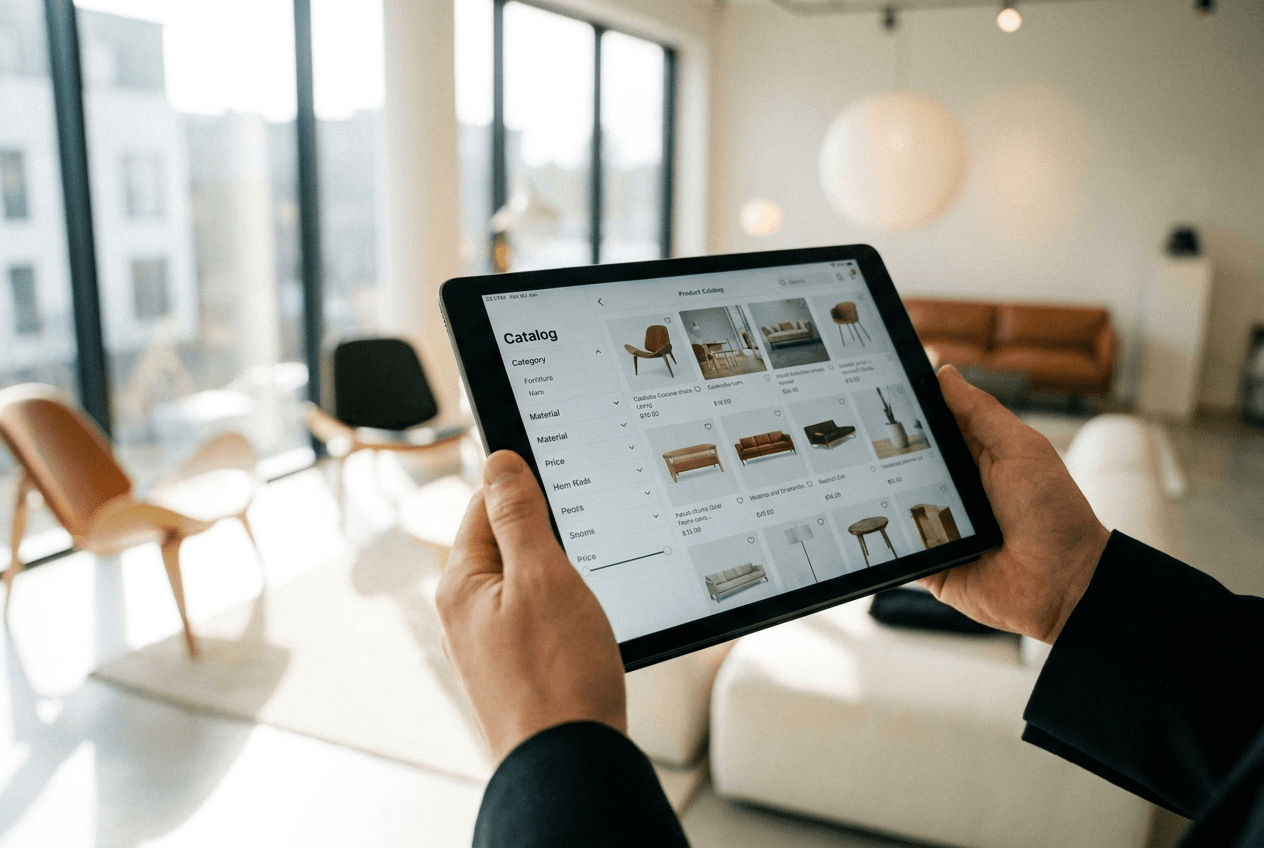
Your range with photos, specs and stock levels, easy search and a quote request straight from a selection. For manufacturers, showrooms and wholesale suppliers.
Three worries people usually bring with a project — and how we handle them.
The PDF catalog goes out of date and stock and prices need checking
Data comes from your inventory system, so the catalog is always current.
Clients can't quickly find the item they need
Filters by real specs: size, material, colour, availability.
Retail and trade partners need different prices
Partners see their own prices and terms after signing in.
Photos, specs and stock for every item.
In every planClients find what they need in a few steps.
In every planA selection of items turns into an enquiry or quote request.
In every planIndividual prices for partners after sign-in.
In every planStock and prices update without manual re-entry.
In every planEasy browsing on a tablet at meetings and exhibitions.
In every planChoose the type, the features you need, the design tier and the timeline — you’ll see a preliminary price range and duration. We fix the exact estimate after a short brief.
Chat messages: goals, users, the features you need.
We fix scope, timeline and cost before work starts.
A prototype and design of the key screens — agreed with you.
We show the result of every stage, and payment is by stage too.
We publish, test and stay in touch for further improvements.
Yes. We set up a one-time import or regular syncing of prices and stock levels, so the catalog stays up to date without manual work.
Yes. Prices and terms can be shown only after sign-in or once a partnership application is approved. Other visitors see the range and send an inquiry.
Yes. If over time some products start selling without a manager's involvement, a cart and checkout can be added to the catalog — we design the architecture with that headroom in mind.
The price depends on the scope: we estimate by features, design and timeline. Describe the task in the calculator on this page to get a “from–to” range, and after the brief we fix the exact estimate. Payment in stages.
The domain and all content are yours from day one. After 12 paid months the website itself is yours too — on request we hand over the source files, access and documentation. Support and further development can stay with us.
We reply during business hours on weekdays — no calls, no pressure.
We reply during business hours on weekdays
Product catalog app development: items with specs and stock, filters, trade prices after sign-in and quote requests from a selection, synced with stock.
If your products are complex, prices depend on volume and a deal usually closes after a conversation with a manager, a classic online store with a cart and checkout isn’t the right fit. A catalogue app solves a different problem: it helps customers make sense of your range, choose what they need and send a precise request instead of calling to ask “what do you have?”. This is a common scenario for furniture, building materials, equipment and wholesale supply.
A PDF catalogue is out of date the day it’s sent: prices change, items sell out, and customers keep forwarding the old version to colleagues. With a small range and infrequent updates, it’s more honest to make do with a good website that has a products section. An app is justified when you have many items, specifications matter for the choice, and managers spend time selecting and forwarding the same things over and over.
The main factor is the structure of your product range. Similar products with a couple of parameters fit into simple product cards, while products with variants, compatibility and interdependent specifications require a well-thought-out data model and filters. The second important part is content: who transfers hundreds or thousands of items with photos and descriptions, how, and whether they need to be prepared from scratch.
The estimate also includes integration with your accounting system for prices and stock, a private area for partners with individual terms, generating quotes, and offline use at trade shows. Format matters too: a web version, a PWA for managers’ tablets or a native app in the app stores. Quite often a web catalogue that opens comfortably on a phone is enough.
We start from how your customers choose products and what questions they ask managers: that list shapes the filters, the product card and search. In parallel we look at where product data is stored today — in your accounting system, spreadsheets or with suppliers — and agree on a single source so the catalogue doesn’t drift from reality.
We test the product import on the full range, not on a dozen samples — that way data errors surface before launch. Managers test product selection and sending requests, after which the catalogue opens to customers. As part of support we monitor synchronisation and add new categories and features — for example, saved selections or reordering past orders for regular partners.
This is custom development, done for you: we run a brief, describe the features, design around your business logic, and agree the design, timeline and estimate before work starts. We take on the architecture, development, integrations and launch.
Cost and timeline depend on the scope — we estimate individually for the task, not from a single price list. After launch we stay in touch: support, improvements and product development.